
Magebean Methodology:
Baseline-Driven Security
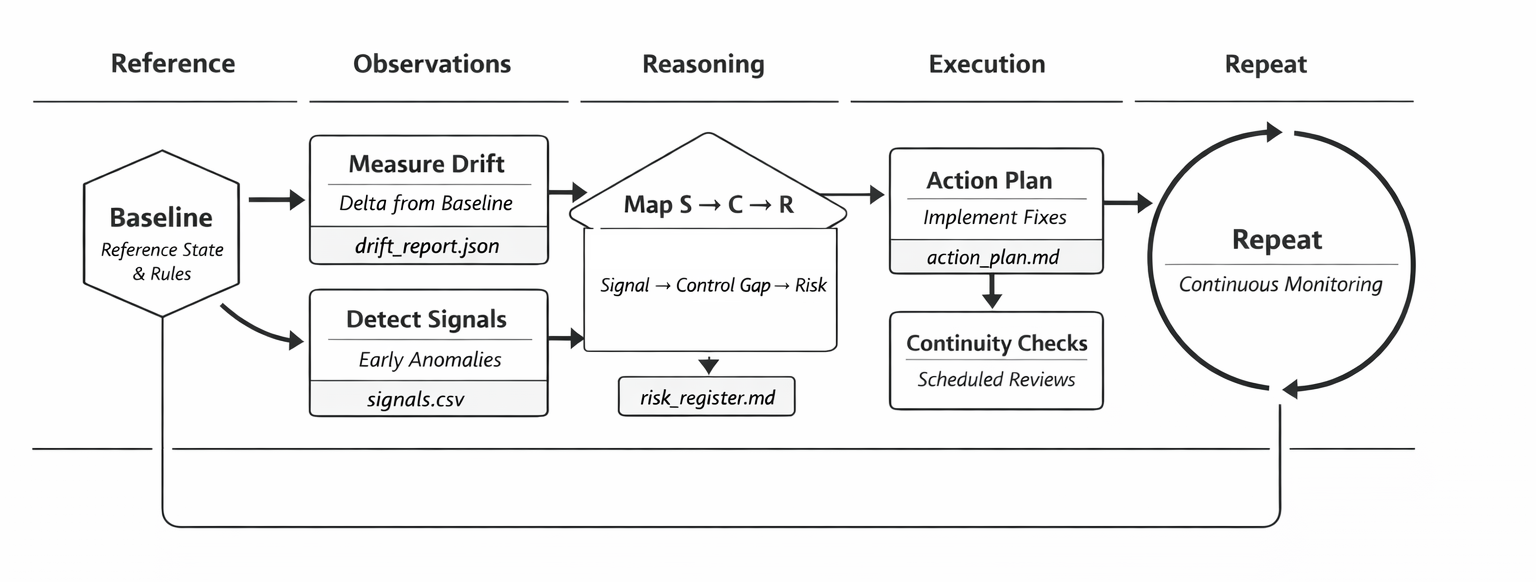
Magebean focuses on one thing: maintaining order over time — by defining a baseline, measuring drift, detecting signals early, and turning them into prioritized actions.
The Principle
Security is not about eliminating all risks.
It is about applying the right controls to reduce prioritized risks to an acceptable level—and keeping that true over time.
Because every control has a cost, security is always a balance between risk reduction and operational overhead.
That balance becomes the baseline.
What “Baseline-Driven” Means
A baseline defines the expected state of a system.
As systems evolve, they naturally drift from that state. Most drift is harmless, but some changes become early signals of increasing risk.
Baseline-Driven Security is a continuous process:
- Baseline — define the expected state.
- Drift — measure change over time.
- Signals — identify what deserves attention.
- Assessment — collect evidence and evaluate the current state.
- Controls — restore order and maintain the baseline.
The goal is not perfect security.
The goal is operational confidence through continuous assessment and maintenance.
The Continuous Cycle
Baseline-Driven Security is not a one-time assessment but a continuous cycle. A baseline defines the expected state, assessment measures drift, signals highlight where attention is needed, and controls restore order. As systems evolve, the cycle repeats—turning security from a reactive task into an ongoing operational practice.
Where Magebean-CLI Runs
Baseline checks are most effective when they happen on a cadence and at gates:
- Pull Request is merged: catch drift before it ships
- Weekly continuity checks: keep drift visible over time
- Release gates: verify controls before major changes
The point is consistency: security stays real only when it stays routine.